
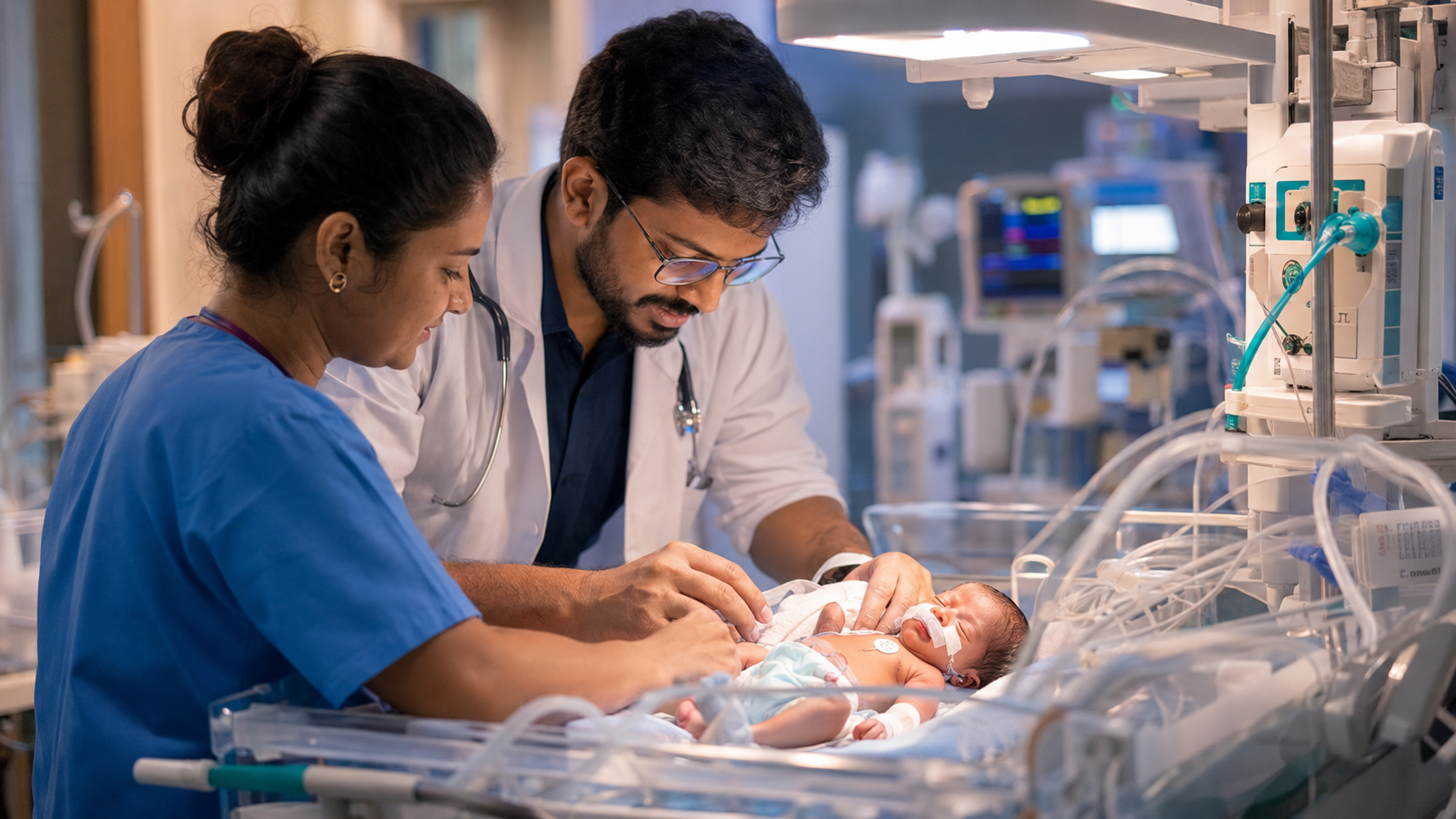

Its Increasing Importance in Modern Healthcare and the Indian Scenario
Neonatology and Its Increasing Importance in Newborn Care
Introduction
Neonatology is a highly specialized branch of pediatrics that focuses on the medical care of newborn babies, especially those who are premature, low birth weight, critically ill, or born with complications. The neonatal period refers to the first 28 days of life, and this is one of the most delicate phases in human survival.
A newborn’s transition from life inside the womb to the outside world is complex. Breathing, temperature control, feeding, immunity, blood circulation, and metabolic balance must all stabilize quickly. For most babies, this happens naturally. But for premature babies, babies with birth asphyxia, infections, congenital anomalies, respiratory distress, or low birth weight, expert neonatal care can make the difference between life, disability, and death.
Globally, newborn deaths still form a major portion of under-five mortality. WHO reported that about 2.3 million newborns died within the first 28 days of life in 2022, accounting for nearly 47% of all under-five deaths. (World Health Organization) This makes neonatology not only a hospital specialty but also a major public-health priority.
What Is Neonatology?
Neonatology is the science and clinical practice of caring for newborn babies, particularly those needing specialized observation or intensive care. A neonatologist is a pediatrician with advanced training in managing newborn emergencies and complex neonatal conditions.
Neonatology commonly deals with:
Premature babies born before 37 weeks of pregnancy, low birth weight babies, respiratory distress syndrome, neonatal jaundice, birth asphyxia, neonatal sepsis, feeding difficulties, congenital anomalies, hypoglycemia, seizures, meconium aspiration syndrome, and babies requiring ventilation or intensive monitoring.
Modern neonatal care is provided through different levels of newborn units, ranging from basic newborn care corners to advanced Neonatal Intensive Care Units, commonly known as NICUs.
Why Neonatology Is Becoming Increasingly Important
1. Rising Survival of Premature and Low Birth Weight Babies
With advances in obstetrics, high-risk pregnancies are being identified earlier. Many babies who would not have survived in the past can now be saved with modern neonatal care. Premature babies may need respiratory support, surfactant therapy, temperature regulation, intravenous nutrition, infection control, and careful neurodevelopmental monitoring.
The goal of neonatology is no longer only survival. The modern goal is intact survival, meaning the baby should survive with the best possible brain, lung, eye, hearing, and developmental outcomes.
2. Better Management of High-Risk Pregnancies
Pregnancies complicated by diabetes, hypertension, fetal growth restriction, multiple gestation, autoimmune disease, infections, congenital anomalies, or assisted reproductive technology may need planned neonatal support at birth. Neonatologists are now an essential part of perinatal teams, working closely with obstetricians, fetal medicine specialists, anesthetists, nurses, lactation counsellors, and pediatric surgeons.
3. Increase in Institutional Deliveries
As more deliveries happen in hospitals, the need for trained neonatal teams has increased. A baby who develops breathing difficulty, poor cry, low oxygen saturation, or hypothermia immediately after birth needs quick, skilled intervention. The first few minutes after birth are crucial, and timely neonatal resuscitation can prevent avoidable deaths and long-term neurological injury.
4. Importance of the First 1,000 Days
The foundation of future health begins before birth and continues through infancy. Neonatal care influences breastfeeding success, growth, immunity, neurodevelopment, and long-term health. A well-managed neonatal period can reduce the risk of developmental delay, recurrent hospitalizations, malnutrition, and chronic complications.
5. Technology-Driven Progress in Newborn Care
Modern neonatology uses advanced but carefully monitored technologies such as CPAP, high-flow oxygen, mechanical ventilation, incubators, radiant warmers, phototherapy, point-of-care ultrasound, blood gas analysis, total parenteral nutrition, central lines, and advanced infection-control systems.
At the same time, simple low-cost interventions remain equally powerful: early breastfeeding, kangaroo mother care, thermal protection, hand hygiene, delayed cord clamping, safe oxygen use, and early recognition of danger signs.
Common Conditions Managed by Neonatologists
Prematurity
Premature babies may have immature lungs, poor temperature control, weak sucking, low immunity, and risk of brain bleeds or eye problems. Neonatology provides structured monitoring and support until the baby becomes stable enough for discharge.
Birth Asphyxia
Birth asphyxia occurs when a baby does not receive enough oxygen before, during, or immediately after birth. Prompt resuscitation and advanced care can reduce the risk of brain injury.
Neonatal Jaundice
Jaundice is common in newborns, but severe jaundice can be dangerous if bilirubin levels rise excessively. Neonatologists decide when phototherapy, investigations, or exchange transfusion may be needed.
Neonatal Sepsis
Newborn infections can progress rapidly. Early diagnosis, antibiotics, blood culture support, and careful monitoring are essential.
Respiratory Distress
Breathing difficulty in newborns may occur due to prematurity, meconium aspiration, pneumonia, transient tachypnea, congenital heart disease, or lung immaturity. NICU respiratory support has dramatically improved survival.
Feeding and Growth Problems
Many preterm or sick babies are unable to feed directly. Neonatal teams support expressed breast milk feeding, tube feeding, lactation counselling, and gradual transition to direct breastfeeding.
The Indian Scenario
India has made significant progress in maternal and child health over the past three decades. Government data released in 2025 noted that India’s neonatal mortality rate has reduced substantially over 30 years, with reductions better than the global average. (Press Information Bureau) UNICEF has also reported that India’s neonatal mortality reduction from 1990 to 2023 was higher than the global reduction during the same period. (UNICEF)
However, India still carries a large absolute burden of newborn deaths because of its large population and high annual birth numbers. UNICEF’s India country data lists India’s neonatal mortality rate at 17 deaths per 1,000 live births, with under-five mortality at 27 per 1,000 live births. (UNICEF DATA)
This means neonatology remains extremely important in India—not only in tertiary hospitals but also in district hospitals, maternity centers, and community-level newborn-care systems.
Special Newborn Care Units in India
One of India’s major public-health steps has been the expansion of facility-based newborn care through Newborn Care Corners, Newborn Stabilization Units, and Special Newborn Care Units.
According to the National Health Mission, Newborn Stabilization Units are typically 4-bedded units at Community Health Centres or First Referral Units for stabilization of sick newborns. Special Newborn Care Units are 12-bedded or larger units located at district or sub-district hospitals and medical colleges, with trained staff and 24×7 services for small and sick newborns. (National Health Mission)
UNICEF reported in December 2024 that India had 1,054 Special Newborn Care Units across the country, supporting the care of vulnerable newborns. (UNICEF) This expansion has helped bring newborn intensive care closer to families who previously had limited access to specialized neonatal services.
Challenges in Neonatal Care in India
Despite progress, several challenges remain.
Many newborn deaths are still linked to prematurity, birth asphyxia, sepsis, low birth weight, delayed referral, lack of transport, poor antenatal risk detection, and uneven access to quality NICU care. Rural and remote regions may still face shortages of trained neonatologists, neonatal nurses, equipment maintenance systems, safe transport services, and follow-up programs.
Another major issue is variation in quality. Having a NICU or SNCU is not enough. Outcomes depend on trained manpower, infection control, rational antibiotic use, breastfeeding support, oxygen monitoring, equipment safety, referral protocols, and proper follow-up after discharge.
India also needs more structured neurodevelopmental follow-up for NICU graduates, especially premature and very low birth weight babies. Saving a newborn is the first step; ensuring good long-term growth, vision, hearing, nutrition, and development is equally important.
Role of Parents in Neonatal Care
Parents are central to newborn recovery. Modern neonatology encourages family-centered care, where parents are educated and involved in feeding, kangaroo mother care, hygiene, emotional bonding, and recognizing danger signs.
Parents should seek urgent medical attention if a newborn has poor feeding, fast breathing, chest retractions, fever, low temperature, bluish discoloration, lethargy, seizures, persistent vomiting, severe jaundice, reduced urine output, or excessive crying with poor activity.
Future of Neonatology
The future of neonatology will combine technology with compassionate, family-centered care. Important future directions include:
Artificial intelligence-assisted monitoring, improved neonatal transport systems, tele-neonatology for remote areas, better antenatal risk prediction, affordable point-of-care diagnostics, human milk banks, antibiotic stewardship, infection-control strengthening, and long-term developmental follow-up clinics.
For India, the next big leap will come from improving quality across all levels—not only in corporate and tertiary NICUs, but also in district hospitals, smaller towns, and rural newborn-care units.
Conclusion
Neonatology is one of the most important and rapidly advancing fields in child healthcare. The first 28 days of life are the most vulnerable period for a child, and expert neonatal care can prevent death, disability, infection, malnutrition, and long-term developmental problems.
In India, neonatal care has improved significantly, supported by institutional deliveries, NICU expansion, SNCUs, government programs, better awareness, and trained healthcare teams. Yet the absolute burden remains high, and the focus must now shift from access alone to quality, safety, early referral, family-centered care, and long-term developmental outcomes.
A strong neonatology system is not only about saving newborns. It is about protecting the future health, intelligence, and potential of the next generation.
One response to “Neonatology”
Hi, this is a comment.
To get started with moderating, editing, and deleting comments, please visit the Comments screen in the dashboard.
Commenter avatars come from Gravatar.